
SEARCH RESULTS Chinese culture Search Criteria: 25 Hits 13 - 24
GoogleMap Loading...
-
 13
13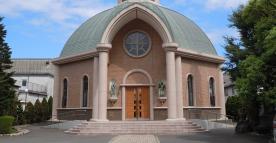
Shimabara Church
In 1932, Shimabara Ninomaru Church was established and dedicated to the martyrs in the Shimabara Rebellion. The church was reconstructed into the present domed building in 1997. -
14
Unzen Church
Constructed to celebrate Pope John Paul II’s visit to Japan in 1981, the church was consecrated to the Jesuit Antonio Ishida of Shimabara (one of the 205 Blessed Japanese Martyrs beatified in 1632), and to the victims tortured to death at the Unzen Hells. -
15
Memorials to Saint Kolbe Hongochi Church・St. Kolbe Memorial Museum・Lourdes in Hongochi
Maximilian Maria Kolbe OFM arrived in Nagasaki from Poland in 1930 and established the monastic order Ordo Fratrum Minorum Conventualium at the foot of Mt. Hiko. He propagated the “Innocent Heart of the Virgin Mary” through its publication Seibo no Kishi (the Knights of the Immaculata). He also met Dr.Nagai in Nagasaki, who gave him a medical examination. St. Kolbe died at Auschwitz. In 1982, Pope Paul II canonized him and also applauded his colleague Friar Zenon for his vigorous missionary activities. Right above the museum, in the neighborhood of Hongochi Monastery, Kolbe found a cave resembling the sacred one at Lourdes in France. Pope John Paul II visited this spot during his tour of Japan in 1981. In 1984, the Vatican officially added the Hongochi Lourdes to its list of pilgrimage sites. -
16
Endo Shusaku Literary Museum
The museum, with its beautiful stained glass windows, exhibits valuable materials commemorating Endo’s Christianity-related literary achievements, as well as his personality and career. The attached café, ‘Enchanté’, serves local food including Fr. De Rotz noodles. -
17
Shitsu Church and Former Shitsu Aid Center Buildings and Fr. de Rotz Memorial Museum
Shitsu Church When he encountered the hidden Christians, Fr. Petitjean realized that there were many other Christians hiding in the Sotome region. He appointed Fr. de Rotz as parish priest of the Shitsu and Kurosaki districts. On a hill commanding a view over the Goto Sea, he established a church at his own expense. A statue of the Virgin Mary that was ordered from France still stands on the bell tower, although the bell is gone, having been given up for metal collection during World War II. The low roofs and the flat or slightly vaulted ceilings are effective in withstanding the strong winds that blow there. Former Shitsu Aid Center Buildings Fr. de Rotz established this facility as a social welfare center. His intention was to help needy women to gain independence. The first floor was used as a food processing plant mainly producing noodles such as macaroni and somen (thin wheat noodles), while the second floor was a factory for making textiles. Three courses in practical subjects such as education, reading, writing and calculation were taught there. Fr. de Rotz Memorial Museum Fr. de Rotz devoted his life to Catholic mission and salvation in the district of Sotome. All the articles he left behind were collected and preserved in the memorial facilities located within the Sotome-Shitsu Cultural Village. A net-making factory which he established was refurbished into the museum to commemorate his great contributions. Among the exhibits are medical appliances, tools and supplies, printed or written documents, and various other materials he used for his missionary and salvation work. The original factory had a sturdy outside wall in front, to protect the building from the strong wind. -
18
Ono Church
The Koteda family fled their home on the island of Ikitsuki and found refuge in the valley of Ono in 1599. Since it was too far from Shitsu, they set up their own church on a hillside overlooking the sea. Fr. de Rotz designed the church with distinctive stone walls called ‘dorokabe’ (translated either as ‘mud walls’ or ‘walls made by de Rotz’). The stone wall was piled up by the parishioners using the natural stones from the area. -
19
Karematsu Shrine
Karematsu Shrine is dedicated to Jiwan, Bastian’s religious leader. He passed away from hunger and cold while hiding in a valley and observing religious practices. The local people buried him and worshipped his tomb as a sacred place. Each November they hold the Karematsu Shrine Festival, when ecumenical prayer services are held as well as a mass conducted by a Catholic priest. This is one of only three shrines in Japan dedicated to holy figures associated with Christianity. -
20
Christians’ Cave at Wakamatsu Island
To evade the persecution of the Goto Kuzure, Christians hid themselves in a 50m-deep cave only accessible by boat. They were discovered when a passing boat saw smoke from their cooking fire, arrested and tortured. Later, this place came to be known as Christians’ Cave, and a 3m statue of Christ was erected at the cave entrance in 1967. Around All Souls’ Day (November 2), the Christians of the nearby parish hold a memorial service here and console the spirits of the ancestors by cooking a meal. Even now, this holy site can only be visited by boat. -
21
Memorial Church and Monument to Martyrdom at the Site of Royanosako Jail
In 1868, more than 200 Christians were imprisoned here in a space of less than 20m2. Crammed into this space, they were ordered to recant their beliefs. 39 prisoners including women and children lost their lives during the eight months of imprisonment. The jail was called Royanosako (the jail pit). On the site, there is a monument engraved with the names of the martyrs. -
22
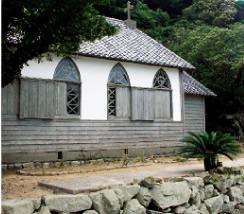
Former Gorin Church
The Former Gorin Church building has an interesting history. Hamawaki Church, built in 1881, was the second oldest wooden church in Nagasaki Prefecture, after Oura Cathedral. In 1931, a new, larger church was to be built at Hamawaki, and the old church was dismantled and then reconstructed as a church for the Gorin district. The church, which has been designated as an Important Cultural Property of Japan, is a rare combination of Japanese- and Western-style construction, with the outer appearance of a traditional Japanese house. -
23
Santo Domingo Church Museum
In 1609, Fr. Francisco Morales, a Dominican priest, suffered persecution and watched as his church in Kyodomari was taken down. But the dismantled materials were brought to Nagasaki and used to build another church on land provided by Murayama Toan, a local magistrate who professed Christianity. However, the newly built church was also destroyed soon afterward in obedience to the Anti-Christian Edicts. The site, where an elementary school is now located, became the residence of the deputy administrator of the shogunate. Recently, during the demolition and reconstruction of the old building, relics of the church and residence were discovered. A museum was opened on the site, and the unearthed objects are now on display as important artifacts related to the early Edo period. -
24
Yamada Church
In the Edo Era (1600-1868), the Ikitsuki Christians hid in secluded spots on the island. In 1878, Fr. Pélu arrived and took charge of missionary activities in the areas around Hirado and Ikitsuki. The hidden Christians were baptized and rejoined the Roman Catholic Church. Tetsukawa Yosuke designed and constructed the church in 1912.