
SEARCH RESULTS Chinese culture Search Criteria: 28 Hits 1 - 12
GoogleMap Loading...
-
 1
1Matsura Historical Museum
The Matsura Historical Museum houses the impressive residence of the Matsura clan, who ruled the island from the 11th to 19th century, and prospered through international trading. Inside the museum, you can dress up in samurai armor or a Japanese Kimono and enjoy the treasures of the Matsura. You can also enjoy an original warrior-style green tea and authentic sweets with its 400 years of tradition at a thatch-roofed tea ceremony house located at the side, in a very quiet natural setting, where you can only hear the songs of the birds and the bamboo. On the other side of the museum, there is a café in a Japanese-style building, furnished with Western furniture. -
2

Kofukuji
Kofukuji is the oldest Chinese Obaku Zen temple in Japan. It traces its humble origins to a small hermitage built in 1620 to pray for the safety of sea voyages, frequent between China and Nagasaki at the time. The temple stands out along teramachi-dori (temple street) due to its impressive red gate. Many important Zen masters have stayed at this temple, including the founder of Obaku Zen Buddhism Ingen, Mokusu Nyojo who built the nearby megane-bashi (spectacles bridge), and Itsunen who introduced a new style of Chinese painting to Japan. Kofukuji’s significance in Japan’s Buddhist history is greatly treasured and protected by Nagasaki Prefecture. Many relics on the temple grounds have been deemed cultural assets of the prefecture and city. The temple itself is an Important Cultural Property of Japan. Visitors can taste Buddhist Vegetarian cuisine here, or enjoy Japanese green tea and sweets in the tea house next to the garden. Kofukuji, together with Sofukuji, Shofukuji and Fukusaiji comprise the “four fortune temples of Nagasaki” (長崎四福寺). -
3

Teramachi-dori (Temple Street)
Tracing their histories some 400 years back, many old temples line teramachi-dori - Nagasaki’s famous temple street. In the 16th and early 17th century, Nagasaki was a hub of international trade, with European and Chinese traders frequenting its ports, bringing goods from around the world. Chinese traders were the largest group and many lived in Nagasaki, establishing temples based on their hometowns. The ruling shogunate which had been tightening control over the region greatly supported Buddhism and the building of temples over the influence of Christianity, enabling Buddhism to thrive in Nagasaki. Well-known temples along this street include Kofukuji and Sofukuji - two of the “four fortune temples” of Nagasaki. Many of these temples or their relics have been classed as cultural assets of the city or prefecture, and even national treasures. -
4
Nagasaki Shinchi Chinatown
Nagasaki Chinatown, located in Nagasaki City is one of the three largest Chinatowns in Japan, alongside those in Yokohama and Kobe. This area is now a popular sightseeing spot for original Nagasaki-style Chinese food and the Nagasaki Lantern Festival, the largest Chinese New Year celebration in Japan. During the national isolation period, Nagasaki Port was opened as an exception for trade with China from 1635. Chinese could reside around Nagasaki City until 1689 when the feudal lord decided to restrict them to a specific ‘Chinatown’ in order to combat commercial fraud. No Japanese citizens were allowed to enter the Chinatown area except geisha and monks, although Chinese people were able to leave to visit the Chinese temples in Nagasaki City, thus transporting Chinese culture to the local Nagasaki people. Trade goods included silk, sugar, medicines and books. Moreover, Chinese culture had a great influence on the people of Nagasaki. Since then, Nagasaki has enjoyed famous Chinese-influenced events year-round, including ‘Shourou Nagashi’ (the Spirit Boat Procession), the Nagasaki Peiron (dragon boat) Championship and the Dragon Dance performed at various festivals. After 1859, with the opening of Japan to foreign countries, the Chinese residents in Nagasaki transferred to Shinchi Town where the current Chinatown is located. Along the 250m of streets meeting at a crossroads, there are about 40 restaurants serving Champon and Saraudon, the famous Nagasaki Chinese cuisine, as well as souvenir shops. This area is popular for tourists especially when decorated with thousands of lanterns during the Lantern Festival. -
5
Confucian Shrine & Historical Museum of China
This shrine is the only one of its kind to have been built by Chinese people outside of China. The Historical Museum of China is also located here and showcases many Chinese national cultural treasures. -
6

Aosagaura Church
The Aosagaura area was settled by Christians from Sotome, who battled harsh living conditions and severe oppression until the ban on Christianity was lifted in 1873. In 1878, they were finally able to build their church, taking charge of missionary work in the whole upper-Goto region. In 1910, a third church building, designed by Tetsukawa Yosuke, reached completion thanks to the hard work of the parishioners, young and old, male and female, who dedicated themselves to tasks such as carrying bricks from boats on the shore uphill to the construction site. Tetsukawa Yosuke had taken part in the construction of Dozaki Church as an apprentice. In 2001, Aosagaura Church was designated a national cultural asset. -
7

Egami Church
Facing the Naru Strait, Egami Church stands on the coast surrounded by a grove of trees. In 1918, the descendants of settlers cooperated to build the church, under the design and surveillance of Tetsukawa Yosuke. Thanks to funds raised by that year’s abundant fish haul, the construction reached a level of perfection rarely seen among wooden churches in Japan. -
8

Nakamachi Church
Dedicated to the 16 Martyrs of Nagasaki, this church is located close to JR Nagasaki Station, and the 26 Martyrs site on Nishizaki Hill. The first Nakamachi Church was built in 1896 using funds donated by an anonymous French person, to commemorate the 330th anniversary of the deaths of the 26 Martyrs and as dedication to the Blessed Virgin Mary. The church was destroyed by the atomic bomb in 1945, but was rebuilt by parishioners in 1951. In 1988, a monuments to the16 Martyrs was constructed in a garden at this church. Cardinal Jaime Sin of Manila attended the unveiling ceremony for the monument, in recognition of Lorenzo Ruiz, the first Filipino saint. In 2015, the little Japanese garden and the monuments to the 16 saints were refurbished to commemorate the 150th anniversary of the “Discovery of the Christians”. -
9
Site of Martyrdom at Arima
Arima Naozumi, the 15th ruler of the domain, recanted his belief in Christianity and initiated the persecution of the Christians. In 1613, on the spacious beach in front of Hinoe Castle, he executed his Christian vassals and their families who had refused to recant. More than 20,000 Christians gathered and watched as the condemned were burned alive. Despite Naozumi’s intention to set an example, the local Christians consolidated their religious belief, spurring the Shogunate to issue the Anti-Christian Edicts the following year. In 2007, the executed Christians were beatified and added to the list of 188 Blessed Japanese Martyrs. -
10

Shima no Yakata: Museum of Ikitsuki
The museum presents information on the history and folklore of the island of Ikitsuki. The large exhibition hall is designed like the inside of a church and displays artifacts related to livelihood and religion. The hidden Christians maintained their faith even under severe oppression, in a unique form mixing Christianity with Buddhism and Shintoism. Fisheries and agriculture thrived in the rich natural environment. The traditional equipment, miniature models and dioramic images inform visitors about the colorful history of Ikitsuki Island. -
11
Site of the Martyrdom at Kurose: Grave of Nishi Gaspar
Nishi Gaspar held a leading position related to the administration of the village. In 1606, he was executed at Kurose-no-Tsuji as the last martyr on the island of Ikitsuki. The execution ground was called Kurose on the basis of the Spanish word cruz (cross). The site is now a park where a large new crucifix has been erected. The grave of Nishi Gaspar and his family is just behind this monument. His son, Tomas Nishi, who was the only survivor, later became a priest in Manila in the Philippines, but was ultimately martyred at Nishizaka in Nagasaki City. -
12
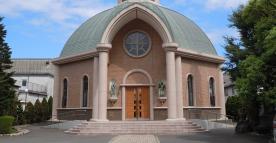
Shimabara Church
In 1932, Shimabara Ninomaru Church was established and dedicated to the martyrs in the Shimabara Rebellion. The church was reconstructed into the present domed building in 1997.