
SEARCH RESULTS Search Criteria: 165 Hits 61 - 72
GoogleMap Loading...
-
 61
61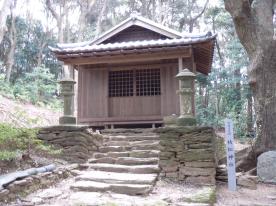
Karematsu Shrine
Karematsu Shrine is dedicated to Jiwan, Bastian’s religious leader. He passed away from hunger and cold while hiding in a valley and observing religious practices. The local people buried him and worshipped his tomb as a sacred place. Each November, locals hold the Karematsu Shrine Festival, when ecumenical prayer services are held as well as a mass conducted by a Catholic priest. This is one of only three shrines in Japan dedicated to holy figures associated with Christianity. -
62
Christians’ Cave at Wakamatsu Island
To evade the persecution of the Goto Kuzure, Christians hid themselves in a 50m-deep cave only accessible by boat. They were discovered when a passing boat saw smoke from their cooking fire, arrested and tortured. Later, this place came to be known as Christians’ Cave, and a 3m statue of Christ was erected at the cave entrance in 1967. Around All Souls’ Day (November 2), the Christians of the nearby parish hold a memorial service here and console the spirits of the ancestors by cooking a meal. Even now, this holy site can only be visited by boat. -
63
Memorial Church and Monument to Martyrdom at the Site of Royanosako Jail
In 1868, more than 200 Christians were imprisoned here in a space of less than 20m2. Crammed into this space, they were ordered to recant their beliefs. 39 prisoners including women and children lost their lives during the eight months of imprisonment. The jail was called Royanosako (the jail pit). On the site, there is a monument engraved with the names of the martyrs. -
64
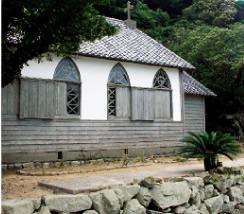
Former Gorin Church
The Former Gorin Church building has an interesting history. Hamawaki Church, built in 1881, was the second oldest wooden church in Nagasaki Prefecture, after Oura Cathedral. In 1931, a new, larger church was to be built at Hamawaki, and the old church was dismantled and then reconstructed as a church for the Gorin district. The church, which has been designated as an Important Cultural Property of Japan, is a rare combination of Japanese- and Western-style construction, with the outer appearance of a traditional Japanese house. -
65
Yamada Church
In the Edo Era (1600-1868), the Ikitsuki Christians hid in secluded spots on the island. In 1878, Fr. Pélu arrived and took charge of missionary activities in the areas around Hirado and Ikitsuki. The hidden Christians were baptized and rejoined the Roman Catholic Church. Tetsukawa Yosuke designed and constructed the church in 1912. -
66

Remains of Hinoe Castle
During the 14th century the family ruling the Shimabara Peninsula constructed a castle named ‘Hinoe-jo’. Harunobu, the 14th lord (1597 – 1612) was a Christian daimyo and refurbished his castle into a large-scale structure with gardens, a tea arbor and many rooms. Stone walls remain around the site of the front gate. A recent survey has revealed that the construction materials including the stone steps were acquired from tombstones in Buddhist graveyards which Harunobu had demolished. This indicated the religious situation in those days, when Christianity was flourishing. In 1982, the location of the castle was designated a National Historical Site. -
67
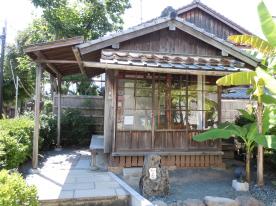
Nyoko-do and Dr. Takashi Nagai Memorial Museum
Nyoko-do (“‘As Thyself’ Hall”) is the small house of Dr. Takashi Nagai, built on the site of a former residence of a ‘chokata’, a leader of hidden Christians. Dr.Nagai, whose wife was a descendant of the chokata, spent his last days here, suffering from leukemia. On his sick bed, he authored numerous books, essays and drawings about Urakami and the lives of his family, hoping to appeal for neighborly love and peace. ‘Nagasaki no Kane’ (‘The Bells of Nagasaki’), about the bomb-damaged bell of Urakami Cathedral, is one of his best-known works. He also left an important report on relief activities for the victims of the atomic bombing, from his point of view as a radiologist. Inside this tiny house of barely two square meters, there is a statue of the Virgin Mary sent from Argentina as a prayer for peace. -
68

Kusuhara Church
Kusuhara was one of the remote areas settled by Sotome Christians around thelate-18th and early-19th centuries. Their descendants underwent ordeals even after the rediscovery of the Christians in Nagasaki. A roundup at Mizunohara expanded into the mountains. The hidden Christians were imprisoned and tortured and their settlements plundered. The site where they were jailed, near to the church, is open to the public. Around 1910, the present church was designed and constructed under the direction of Tetsukawa Yosuke. The building was repaired and improved in 1968. -
69
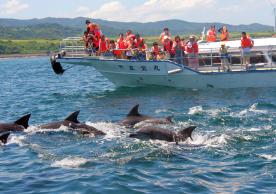
Dolphin Watching (from Kazusa)
Approximately 300 wild dolphins live in the sea between the Shimabara Peninsula and Amakusa. The dolphin watching cruises have become increasingly popular for all ages, especially because it is possible to see the dolphins so close that you could almost touch them. Join one of the various tours departing from Kazusa, Kuchinotsu or Minami Arima to watch playful dolphins frolicking in the sea! -
70
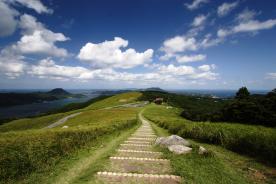
Kawachi toge Pass
From the top of Kawachi-toge Pass one has a unique panoramic view. To the west are the northern Ninety-Nine Islands, to the north the beginning of the Genkai Sea and further away one can spot Iki Island and Tsushima Island. It is close to Hirado City and is a popular spot for hikers, tourists and locals alike. -
71
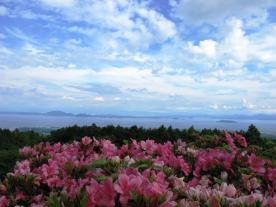
Tawaraishi Viewpoint
The Tawaraishi Viewpoint is located at the conjunction between National Road 57 and Prefectural Road 132 in the direction of Mount Unzen. From this place it is possible to enjoy a beautiful view of Kujukushima Chichibu Ga Ura Park in Shimabara City and the Southern part of the Shimabara Peninsula. The Tawaraishi Viewpoint has been nominated as one of the 100 best new touristic attractions in Nagasaki Prefecture. -
 72
72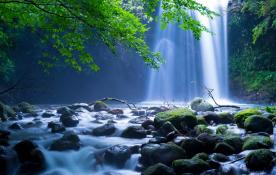
Ayugaeri Waterfall
Ayugaeri Waterfall is a popular tourist location inside the Unzen-Amakusa National Park. The waterfall gets its name from the local fish Ayu, that have migrated to the nearby the basin for decades. Whether you want to take a dip in the basin, or slide down the smooth rock slab at the top, you’re sure to find respite from the summer heat. Thanks to calm waters, many families flock to the area and children are more than welcome. Above the waterfall there is a teahouse “Taki no Chaya” where you can enjoy the city’s local specialty nagashi-soumen (soumen noodles caught in flowing noodles). Cooked in the cool waters from surrounding currents, they make for a satisfying feed after a swim.