
SEARCH RESULTS History Search Criteria: 93 Hits 85 - 93
GoogleMap Loading...
-
 85
85
Minami Shimabara Olle trail course
Located along the southern tip of Shimabara peninsula, the Minami Shimabara Olle course is a great walk for all experience levels. The 10km marked trail begins in the town of Kuchinotsu, leading walkers around the charming little port town, through woods and rolling hills, before coming to an end along the beautiful coastline of the Ariake Sea. Sights not to miss include the Sezumesaki Lighthouse and the chance to walk along the rocky volcanic coastline at low-tide. This course can be accessed by car or bus from Shimabara, Obama or Isahaya. Level: Beginner Time required: 3-5hrs (return) More information in the Mountain Madness special article available early 2017! -
86
Shitsu Church and Former Shitsu Aid Center Buildings and Fr. de Rotz Memorial Museum
Shitsu Church When he encountered the hidden Christians, Fr. Petitjean realized that there were many other Christians hiding in the Sotome region. He appointed Fr. de Rotz as parish priest of the Shitsu and Kurosaki districts. On a hill commanding a view over the Goto-nada Sea, he established a church at his own expense. A statue of the Virgin Mary that was ordered from France still stands on the bell tower, although the original bell is gone, having been given up for metal collection during World War II. The low roofs and the flat or slightly vaulted ceilings are effective in withstanding the strong winds that blow there. Former Shitsu Aid Center Buildings Fr. de Rotz established this facility as a social welfare center. His intention was to help the women in need to gain independence. The first floor was used as a food processing plant mainly producing noodles such as macaroni and somen (thin wheat noodles), while the second floor was a factory for making textiles. Three courses in practical subjects such as education, reading, writing and calculation were taught there. Fr. de Rotz Memorial Museum Fr. de Rotz devoted his life to Catholic mission and salvation in the district of Sotome. All the articles he left behind were collected and preserved in the memorial facilities located within the Sotome-Shitsu Cultural Village. A net-making factory which he established was refurbished into the museum to commemorate his great contributions. Among the exhibits are medical appliances, tools and supplies, printed or written documents, and various other materials he used for his missionary and salvation work. The original factory had a sturdy outside wall in front, to protect the building from the strong wind. -
87
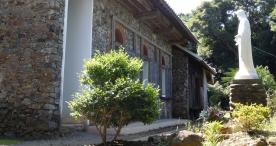
Ono Church
The Koteda family fled their home on the island of Ikitsuki and found refuge in the valley of Ono in 1599. Since it was too far from Shitsu, they set up their own church on a hillside overlooking the sea. Fr. de Rotz designed the church with distinctive stone walls called ‘dorokabe’ (translated either as ‘mud walls’ or ‘walls made by de Rotz’). The stone wall was piled up by the parishioners using the natural stones from the area. -
88
Endo Shusaku Literary Museum
The Endo Shusaku Literary Museum chronicles celebrated Japanese author Endo’s life and study and holds a collection of over 30,000 articles - largely Christian-related - including original written manuscripts and books relating to his writings. The most notable of which, Silence, has been translated to English and turned into an English-language film (Silence, 2016). This museum is located in Sotome that is a one hour drive away from Nagasaki City. It overlooks the Goto-nada Sea and is a picturesque spot for watching the sun set. The district was home to persecuted Christians during the ban on Christianity and is known as the hometown of Christians in Japan. While not originally from Nagasaki, Endo felt a strong bond with the district, calling it his second home. It was therefore the wish of his family that the museum be built in Sotome. The attached café, ‘Enchanté’, serves local food including Fr. De Rotz noodles. -
89
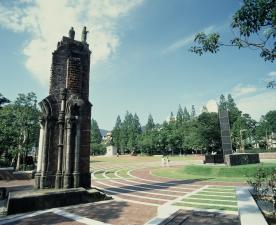
Nagasaki Hypocenter Park
At 11:02 am, August 9th, 1945: an atomic bomb detonated 500 meters above Matsuyama in Nagasaki City. Large numbers of people were killed immediately, while others died later from illness or injury - by the end of December, some 74,000 people had died while around 75,000 more suffered from injuries associated with the event. The area within a 2.5 kilometer radius of the hypocenter was utterly devastated, and the rest of the city was left in ruins. In 1968, a memorial monolith was built in the hypocenter park to mark ground zero of the atomic explosion. Beside the monolith, a part of the relics of the former Urakami Cathedral is preserved. A layer of the ground at that time is exhibited at the site, where visitors can see the remains of destroyed houses: roof tiles, bricks, ceramic and pieces of glass that boiled in the 3000℃ atomic heat. After the bombing, which destroyed all plant life around the hypocenter, people said that no plants would grow there for the next 70 years. However, one month after the atomic bombing, about 30 kinds of plants started to grow again. Today, there are bout 500 cherry blossom trees in the hypocenter park. The park is a favorite spot among local people for cherry blossom viewing in the spring time and as a green-filled oasis throughout the year. It truly captures the power of revival. Take a stroll around the many sites in the area: the Atomic Bomb Museum, the National Peace Memorial Hall for the Atomic Bomb Victims, the Peace Park, Urakami Cathedral with its atomic-bombed statue of the Virgin Mary, the Dr. Nagai Museum (a doctor and survivor of the atomic bombing), the local elementary school affected by the bombing with its own peace museum, the one-legged torii gate of Sanno Shrine and its surrounding camphor trees that survived the bombing. These are all located within walking distance. -
90
Santo Domingo Church Museum
In 1609, Fr. Francisco Morales, a Dominican priest, suffered persecution and watched as his church in Kyodomari was taken down. But the dismantled materials were brought to Nagasaki and used to build another church on land provided by Murayama Toan, a local magistrate who professed Christianity. However, the newly built church was also destroyed soon afterward in obedience to the Anti-Christian Edicts. The site, where an elementary school is now located, became the residence of the deputy administrator of the shogunate. Recently, during the demolition and reconstruction of the old building, relics of the church and residence were discovered. A museum was opened on the site, and the unearthed objects are now on display as important artifacts related to the early Edo period. -
91
Memorial to the Martyrdom of the 26 Saints of Japan
On February 5, 1597, twenty-six Catholics were executed here under the orders of Toyotomi Hideyoshi, marking the beginning of a two century long period of harsh Christian persecution in Japan. Today, this spot on Nishizaka Hill has been deemed a Japanese National Sanctuary. Pope St. John Paul II visited this site on February 26, 1981 as a pilgrim for the martyrs. Background In the late 1500s, the government had begun to grow wary of foreign influence. In order as to gain complete control over Kyushu, Toyotomi Hideyoshi issued an order to expel all priests from the country. The growing tension culminated in the arrest of six missionaries (including Spaniards, Mexicans, and Portuguese) and eighteen Japanese Christians in Kyoto and Osaka (some of whom had come from Nagasaki). They were forced to make the 800km walk to Nagasaki, chosen for its significant Christian population. They were joined by two more Catholics along the way. The journey took a month to complete, and when they finally made it to Nishizaka Hill, they were executed in front of the masses. Many more tragically followed. The martyrs were beatified in 1627, and canonized by the Pope in 1862. The Twenty-Six Martyrs Monument A monument dedicated to St. Paul Miki and his twenty-five companions was built at the site of the martyrdom in commemoration of the 100th anniversary of their canonization. This monument faces the one at Oura Cathedral that is also dedicated to the martyrs. The Twenty-Six Martyrs Museum Behind the monument stands the Twenty-Six Martyrs Museum. At this museum, visitors can learn about the history of Christianity in Nagasaki - its rise, its prohibition, and its revival. A collection of items showcasing the lives of Christians as they hid from the authorities are on display here. These artifacts include a scroll depicting St. Mary of the Snows (meticulously preserved by the faithful Hidden Christians in spite of the risk it posed), the "Maria Kannon" – the Buddhist Kannon used by Hidden Christians as the statue of Mary for worship, and personal belongings amongst others. There is also a collection of old maps and an original letter of St Francis Xavier's. A replica of the scroll of St. Mary of the Snows appears in the movie Silence (more information under Topics). Twenty-Six Martyrs Memorial St. Philip's Church (Nishizaka Church) Prominent for its uniquely designed twin towers that one may catch a glimpse of in the city area, this church, influenced by Gaudi and designed by Kenji Imai, is a church named after one of the martyrs. St. Paul Miki, St. Jacob Kisai, and St. John Goto's bones are stored here. This church is currently open for prayer and receives pilgrims from many nations every year. -
92
The Nagasaki Atomic Bomb Museum
The Nagasaki Atomic Bomb Museum covers the history of this event in the accessible form of a story. It begins with the disastrous scene of the attack and includes the events leading up to the dropping of the atomic bomb, the reconstruction of Nagasaki up to the present day, the history of nuclear weapons development, and the hope for a peaceful world free of nuclear weapons. -
93
Siebold Memorial Museum
Philipp Franz von Siebold first came to Japan with the Dutch East India Company in 1823 as a doctor. Throughout his time in Nagasaki, he introduced Western medicine to Japanese doctors and contributed greatly to research in medicine and botany. He was barred from Japan after it was found that he was smuggling maps to Europe but returned 30 years later to reunite with his Japanese family and students. In the years he spent away, he wrote notable books including Nippon (1832-1851), and Flora Japonica (1835-1844) which were met with great interest and success in the West. This museum, modelled after his former residence in Leiden, the Netherlands and located near the school he established in Nagasaki, consists of three floors, dedicated to telling the life story and contributions of the man.