
SEARCH RESULTS Search Criteria: 165 Hits 1 - 12
-
 1
1Sotome Museum of History and Folklore
This museum features two floors of exhibits that showcase the rich and unique history of Sotome. From tools and machines used in olden Japan to artifacts collected from the Hidden Christian era, the Sotome Museum of History and Folklore is a record of the development of society, cultural exchange, and tragedy of the Christian persecution in Japan. English brochures are available for the first floor exhibits on tools and machinery and although none are for the second floor hidden Christian artifacts, it is worth a look for visitors interested in the Christian heritage of Nagasaki. You can listen to a recording of orasho (prayers by hidden Christians passed down through the generations) on the second floor. -
2

Omura Sumitada Historical Park
Omura Sumitada was Japan’s first Christian Daimyo (Samurai war lord), who with foresight and vision sent a group of young Japanese emissaries to Rome (known as the “Tensho Embassy”).This park was built at the residence where Omura Sunitada breathed his last breath. A garden with a fountain and its clean flow of water still remains as the core attraction of the park. Visitors can learn some historical facts about Sumitada including details of local Japanese Christians and trading with the West. -
3
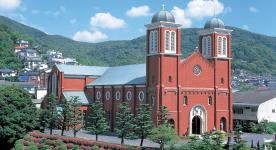
Urakami Cathedral
Urakami Cathedral, located 500 meters north of the hypocenter. It was once renowned for being the largest Roman Catholic church in the East but was completely demolished by the nuclear blast. Now you can see the headless statues of the saints, the bell tower that was blown off by the atomic bomb and a wooden figure of the Virgin Mary which miraculously survived the heat of the nuclear blast. More details: In 1895, with the assistance of Fr. Pierre Fraineau MEP, the Christian faithful began the construction of Urakami Cathedral on the land o the former village headman, the very place where the custom of trampling on a Christian image (e-bumi), had been enforced as a way to expose hidden Christians. In 1914, a ceremony was held to bless the church and dedicated it to the Virgin Mary. However, just 30 years later, on August 9th, 1945, the church was devastated by the atomic bomb. Nevertheless, on Christmas Eve that year, the survivors rang the church bell that they dug out of the ruins, and went on to rebuilt the church. The new reinforced concrete building was completed in 1959, and an outer layer of bricks was added in 1980. In 1962, meanwhile, the new Urakami church replaced Oura Catholic Church as the Cathedral of the Nagasaki Archdiocese. The following monuments can be seen today in the precincts: - The Atomic-Bombed Statue of Mary - The Fallen Bell Tower: The original church had twin bell towers. One was crushed by the atomic explosion, another was blown about 25 meters away by the blast. It is preserved as National Important Asset at the original site. - Headless Statues of Saints: Stone statues that were exposed to the atomic bombing. - The Monument of Faith: Commemorating the 50th anniversary of Urakami Yonban Kuzure (the fourth collapse of the Christian community of Urakami resulting from the government's drastic policy of oppression and expulsion.) -
4

Mt. Onidake
Mt. Onidake, a symbol of Goto, is a 315-meter cinder-cone volcano, which last erupted an estimated 18000 years ago. The volcano, which is covered in grass, is well-known as a venue for an annual kite-flying event, and as a leisure spot -
5
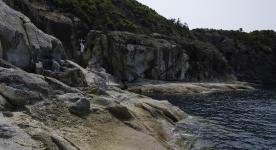
Christian’s Cave and the ‘Eye of the Needle’
It is said that during the repression of Christianity during the Meiji Era, believers lived in hiding in this cave. A 4-meter tall cross and a 3.6-meter statue of Jesus were built in 1967. Even now the cave is only accessible by boat. -
 6
6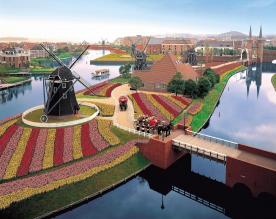
Huis Ten Bosch
Huis Ten Bosch is a residential-style resort built after a mediaeval 17th century Dutch town. Palace Huis Ten Bosch, built with special permission from the Dutch royal family, is a reproduction of the residence of Her Majesty the Queen of The Netherlands. In English, Huis Ten Bosch means “house in the forest.” And true to its name this residential-style resort has canals running throughout, and is surrounded by greenery, forests, amusements, shops, restaurants, five distinct hotels, a marina and residential area. It is also known for the Flower Kingdom, where flowers bloom throughout the year. The “Gardening World Cup” a competition between the top gardeners in the world, has won the 2013 Canadian and International Garden Tourism Award. Huis Ten Bosch also celebrates summer with the “World Firework Contest”. The “Winter Light Festival” has been ranked by Yahoo as the top illumination display in Japan for three consecutive years. Various types of entertainment are also available, from restaurants to spas, marine sports and shopping, offering visitors a number of ways to enjoy their stay. Furthermore, there are also plenty of attractions for families with young children include cruising on the pirate ship from the popular cartoon ‘One Piece’. Huis Ten Bosch is a resort theme park that has offered visitors enjoyment for three generations. Moreover, the “Next Generation Park”, an environmentally-advanced area based on the concept of sustainable systems, was opened in 2010. -
7
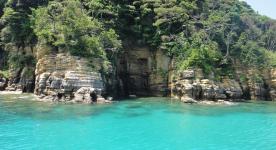
Tatsunoshima Island
Tatsunoshima Island seems to float upon the vivid blue ocean. View the uniquely eroded stacks, caves and arches, as well as “Snake Valley”, named for the narrow gorge that snakes between 50-meter cliffs. If you are a thrill-seeker, you can walk along the top of the cliff. The island’s beach with its fine white sand and calm crystal-clear waters is the perfect place to relax. -
8
Matsura Historical Museum
The Matsura Historical Museum houses the impressive residence of the Matsura clan, who ruled the island from the 11th to 19th century, and prospered through international trading. Inside the museum, you can dress up in samurai armor or a Japanese Kimono and enjoy the treasures of the Matsura. You can also enjoy an original warrior-style green tea and authentic sweets with its 400 years of tradition at a thatch-roofed tea ceremony house located at the side, in a very quiet natural setting, where you can only hear the songs of the birds and the bamboo. On the other side of the museum, there is a café in a Japanese-style building, furnished with Western furniture. -
9
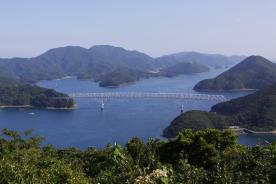
Wakamatsu Bridge
The white truss bridge which joins Shinkamigoto’s Nakadori Island and Wakamatsu Island interweaves with the blue ocean, azure sky and the green mountains to create a splendid view over the Wakamatsu Strait. A popular viewing spot for this bridge is Mt. Ryukan (Ryukansan). You can also get a closer look at the nearby shore below the bridge. -
10

Banshoin
This Buddhist temple was built in 1615 by the Soh family, rulers of Tsushima Island during the Edo Period. This is the location of one of the three largest graveyards in Japan. -
11

Kofukuji
Kofukuji is the oldest Chinese Obaku Zen temple in Japan. It traces its humble origins to a small hermitage built in 1620 to pray for the safety of sea voyages, frequent between China and Nagasaki at the time. The temple stands out along teramachi-dori (temple street) due to its impressive red gate. Many important Zen masters have stayed at this temple, including the founder of Obaku Zen Buddhism Ingen, Mokusu Nyojo who built the nearby megane-bashi (spectacles bridge), and Itsunen who introduced a new style of Chinese painting to Japan. Kofukuji’s significance in Japan’s Buddhist history is greatly treasured and protected by Nagasaki Prefecture. Many relics on the temple grounds have been deemed cultural assets of the prefecture and city. The temple itself is an Important Cultural Property of Japan. Visitors can taste Buddhist Vegetarian cuisine here, or enjoy Japanese green tea and sweets in the tea house next to the garden. Kofukuji, together with Sofukuji, Shofukuji and Fukusaiji comprise the “four fortune temples of Nagasaki” (長崎四福寺). -
12
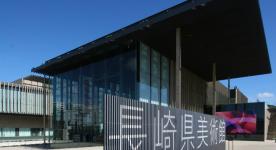
Nagasaki Prefectural Art Museum
Nagasaki Prefectural Art Museum was designed by the world-famous Japanese architect Kengo Kuma. Bisected by a canal, the building features a green rooftop garden from which a panoramic view of the Nagasaki Port and the lush greenery of the Seaside Park can be enjoyed. This one-of-a-kind design has received many prizes in building and illumination design competitions including the Marble Architecture Award 2005 (Italy). The main gallery exhibits attractive collections including the largest collection of Spanish artwork in the East, as well as works related to Nagasaki. Facilities include the Museum Shop, offering well-designed original goods and gifts, and the Cafe, which offers an amazing view high above the canal. The museum holds workshops, concerts and many other community events.Admission is free, excluding the Galleries.