
SEARCH RESULTS Architecture and Landscape Search Criteria: 114 Hits 13 - 24
GoogleMap Loading...
-
 13
13
Haru-no-Tsuji Ruins
The archeological remains at Haru-no-Tsuji are located on a flat plain between Ishida Town and Ashibe Town. The area has provided important insights into life during the Yayoi Period (approx 300BC - 300AD) and has been designated as a site of National Historical Interest. The moated settlement is regarded as the location of the ancient capital of Iki, a country that existed in that period. It appears in a Chinese historical text “The Records of the Three Kingdoms”, as the oldest kingdom in Japan. 17 buildings have been restored at the site. -
14

Osezaki Lighthouse
This white lighthouse is located at Osezaki Cliff, which was formed by erosion from the wild waves of the East China Sea. The combination of the lighthouse, the cliff and the surrounding natural environment presents a spectacular view. -
15
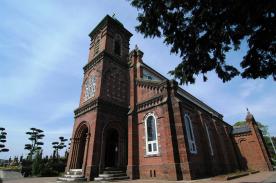
Tabira Church
The church was designed by Tetsukawa Yosuke, a famous architect of various churches in Nagasaki Prefecture, and built between December 1915 and October 1917. It is one of the latest brick churches in the prefecture of Nagasaki. Tetsukawa Yosuke has called this one of his best works. -
16

St. Francis Xavier Memorial Church, a view of a Christian Church and Japanese Temples
Constructed in 1913 as the Hirado Catholic Church, it was relocated to its present site in 1931. The statue of St. Francis was erected in 1971 to to honour the missionary’s visit to Hirado in 1550, and the church later given its present name. An exotic view of a Japanese temples with this church from a street down to the town was described by the Lonly Planet as "one of the most photogenic vantage points in all of Khushu." -
17

Hirado Castle
Hirado Castle offers a commanding view of Hirado Port and the ancient forest of Kurokojima Island. Its museum contains many valuable relics dating back to the Hirado’s feudal past. -
18
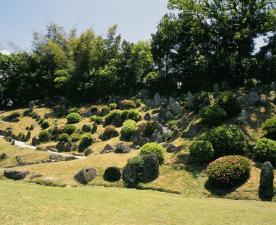
Stone Garden of the Former Enyu-ji Temple
Enyu-ji Temple was built by the fourth domain chief Suminaga in 1652. Designed in the “stone garden” style of the early days of the Edo period, the garden uses a variety of stone combinations with over 400 stones along a slope stretching some 50 meter east-west. Reminiscent of the original grandeur of the garden, it also features a gardening concept that simulates a san-sui (mountain-water) landscape painting with water flows simulated by white pebble stones, and dry falls and flows created using the natural topography. -
19
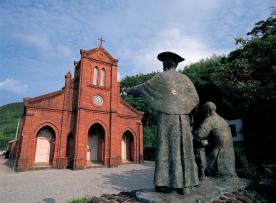
Dozaki Church
This is the oldest church in the Goto islands, and it was built by French missionaries. It now serves a museum displaying historical documents relating to Christians and the 300-year period of suppression of Christianity. It was designated as a Tangible Cultural Asset of Nagasaki Prefecture in 1974. -
20
Shirakimine Plateau and the Cosmos Flower Space Hall
The Shirakimine plateau overlooks the Ariake Sea and presents a breathtaking sight. During Spring, over 100,000 flowers blossom, covering the plateau in a rippling yellow coat. Then later, in Autumn, 200,000 pink, white and red flowers blossom, creating a beautiful vista. Hikers travel from all over Japan, to take in the vista. Nearby, at the Cosmos Flower Space Hall there is a high-powered astronomy telescope which offers spectacular views of the night sky. -
21

Kashiragashima Church
Kashiragashima ChurchThis sandstone church, a rare sight in Japan, was built by Christians returning to the islands after the period of persecution, from stones they quarried themselves. The church is designated as an Important Cultural Property of Japan and is part of the “Churches and Christian Sites in Nagasaki” bid for designation as a World Heritage Site. -
22
Old Samurai Warriors’ Houses
On the west side of Shimabara Castle, the samurai residences have been carefully preserved, complete with clear spring water flowing in canals down the center of the streets. -
23
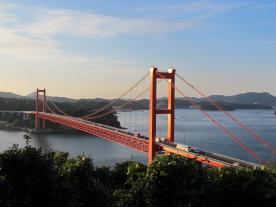
Hirado Bridge
The bridge, linking Hirado Island to the Tabira district, was completed in 1977. The truss suspension design has a total length of 665 meters, with a main span of 465.4 meters and a width of 10.7 meters. It is suspended 30 meters above sea level. -
24
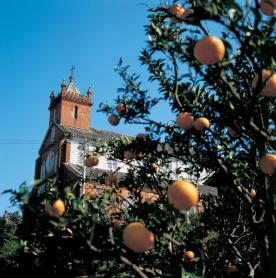
Kuroshima Church
Kuroshima Island is the largest of the Kujukushima islands. Two months after the discovery of the hidden Christians in Oura Cathedral in 1865, 20 representatives of the hidden Christians visited Father Petitjean in Oura to confess their faith. Subsequently, Father Poirier read the first mass in Kuroshima Island at the house of Daikichi Deguchi, one of the representatives. By 1873, Kuroshima had become an "island of Catholic." Kuroshima Church was constructed through the endeavors of Father Marman, with the self-sacrificing cooperation of the local laypeople. They carried bricks and other necessary materials by themselves, climbing up the steep slope from the beach.The interior of this church is magnificent, with arcades, triforia and clerestory. Kuroshima Church is unique in that Arita porcelain tiles, granite quarried in Kuroshima and other local materials are used.