
SEARCH RESULTS Architecture and Landscape Search Criteria: 114 Hits 37 - 48
GoogleMap Loading...
-
 37
37Nagasaki Airport
Situated in the middle of Nagasaki Prefecture in Omura Bay, Nagasaki Airport is the world’s first airport built on the sea. Other than daily domestic flight departures, there are also international flights to neighbouring countries. English speaking staff are available at the information counter. -
38
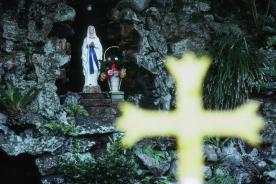
Imochiura Church and Lourdes
This church was constructed under the direction of French missionary Father Peroud. Located near the church is the first Lourdes grotto in Japan, which was built in response to Father Peroud’s exhortation, and modeled after the Massabielle Grotto in Lourdes in the south of France. -
39
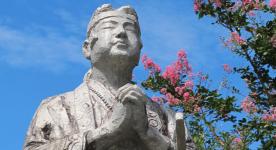
Remains of Hara Castle, Site of Shimabara-Amakusa Rebellion
The Matsukura clan, who gained control of the whole of Shimabara area (including the Arima domain once controlled by the Christian daimyo Harunobu Arima), imposed forced labor and excessive taxes on the local peasants of the area. Suffering from famine and overexertion, in 1637 the peasants of the Arima domain took up arms together with the peasants of Amakusa (who suffered from similar oppression) and revolted against their lords in what became known as the Shimabara-Amakusa Rebellion. Roughly 37,000 peasants gathered and were besieged at the site of Hara Castle, the castle of the Arima clan which had been dismantled under a law which allowed only one castle per province. The siege lasted for 88 days, and ended with the slaughter of every rebel, including women and children. Hara Castle was completely demolished after that, but archaeological investigation has revealed countless human bones, crucifixes and medallions. It is thought that the faith that had remained since the time of Harunobu Arima’s reign enabled the rebels to hold out at the castle site for so long both isolated and unaided. -
40

Aosagaura Church
The Aosagaura area was settled by Christians from Sotome, who battled harsh living conditions and severe oppression until the ban on Christianity was lifted in 1873. In 1878, they were finally able to build their church, taking charge of missionary work in the whole upper-Goto region. In 1910, a third church building, designed by Tetsukawa Yosuke, reached completion thanks to the hard work of the parishioners, young and old, male and female, who dedicated themselves to tasks such as carrying bricks from boats on the shore uphill to the construction site. Tetsukawa Yosuke had taken part in the construction of Dozaki Church as an apprentice. In 2001, Aosagaura Church was designated a national cultural asset. -
41

Egami Church
Facing the Naru Strait, Egami Church stands on the coast surrounded by a grove of trees. In 1918, the descendants of settlers cooperated to build the church, under the design and surveillance of Tetsukawa Yosuke. Thanks to funds raised by that year’s abundant fish haul, the construction reached a level of perfection rarely seen among wooden churches in Japan. -
42

Nakamachi Church
Dedicated to the 16 Martyrs of Nagasaki, this church is located close to JR Nagasaki Station, and the 26 Martyrs site on Nishizaki Hill. The first Nakamachi Church was built in 1896 using funds donated by an anonymous French person, to commemorate the 330th anniversary of the deaths of the 26 Martyrs and as dedication to the Blessed Virgin Mary. The church was destroyed by the atomic bomb in 1945, but was rebuilt by parishioners in 1951. In 1988, a monuments to the16 Martyrs was constructed in a garden at this church. Cardinal Jaime Sin of Manila attended the unveiling ceremony for the monument, in recognition of Lorenzo Ruiz, the first Filipino saint. In 2015, the little Japanese garden and the monuments to the 16 saints were refurbished to commemorate the 150th anniversary of the “Discovery of the Christians”. -
43
Site of Martyrdom at Arima
Arima Naozumi, the 15th ruler of the domain, recanted his belief in Christianity and initiated the persecution of the Christians. In 1613, on the spacious beach in front of Hinoe Castle, he executed his Christian vassals and their families who had refused to recant. More than 20,000 Christians gathered and watched as the condemned were burned alive. Despite Naozumi’s intention to set an example, the local Christians consolidated their religious belief, spurring the Shogunate to issue the Anti-Christian Edicts the following year. In 2007, the executed Christians were beatified and added to the list of 188 Blessed Japanese Martyrs. -
44

Shima no Yakata: Museum of Ikitsuki
The museum presents information on the history and folklore of the island of Ikitsuki. The large exhibition hall is designed like the inside of a church and displays artifacts related to livelihood and religion. The hidden Christians maintained their faith even under severe oppression, in a unique form mixing Christianity with Buddhism and Shintoism. Fisheries and agriculture thrived in the rich natural environment. The traditional equipment, miniature models and dioramic images inform visitors about the colorful history of Ikitsuki Island. -
45
Site of the Martyrdom at Kurose: Grave of Nishi Gaspar
Nishi Gaspar held a leading position related to the administration of the village. In 1606, he was executed at Kurose-no-Tsuji as the last martyr on the island of Ikitsuki. The execution ground was called Kurose on the basis of the Spanish word cruz (cross). The site is now a park where a large new crucifix has been erected. The grave of Nishi Gaspar and his family is just behind this monument. His son, Tomas Nishi, who was the only survivor, later became a priest in Manila in the Philippines, but was ultimately martyred at Nishizaka in Nagasaki City. -
46
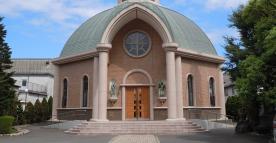
Shimabara Church
In 1932, Shimabara Ninomaru Church was established and dedicated to the martyrs in the Shimabara Rebellion. The church was reconstructed into the present domed building in 1997. -
47
Unzen Church
Constructed to celebrate Pope John Paul II’s visit to Japan in 1981, the church was consecrated to the Jesuit Antonio Ishida of Shimabara (one of the 205 Blessed Japanese Martyrs beatified in 1632), and to the victims tortured to death at the Unzen Hells. -
48
Memorials to Saint Kolbe Hongochi Church・St. Kolbe Memorial Museum・Lourdes in Hongochi
Maximilian Maria Kolbe OFM arrived in Nagasaki from Poland in 1930 and established the monastic order Ordo Fratrum Minorum Conventualium at the foot of Mt. Hiko. He propagated the “Innocent Heart of the Virgin Mary” through its publication Seibo no Kishi (the Knights of the Immaculata). He also met Dr.Nagai in Nagasaki, who gave him a medical examination. St. Kolbe died at Auschwitz. In 1982, Pope Paul II canonized him and also applauded his colleague Friar Zenon for his vigorous missionary activities. Right above the museum, in the neighborhood of Hongochi Monastery, Kolbe found a cave resembling the sacred one at Lourdes in France. Pope John Paul II visited this spot during his tour of Japan in 1981. In 1984, the Vatican officially added the Hongochi Lourdes to its list of pilgrimage sites.