
SEARCH RESULTS Architecture and Landscape Search Criteria: 114 Hits 97 - 108
GoogleMap Loading...
-
 97
97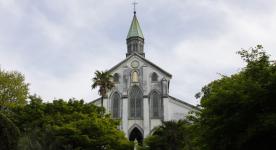
Oura Cathedral
Oura Cathedral is the oldest wooden church of gothic architecture existing in Japan. It was built in 1864 by a French missionary, and was thus known by the people of Nagasaki at the time as the “French Temple”. This church was dedicated to the 26 martyrs who had been executed on Nishizaka Hill; the bronze statues in Oura Cathedral and on Nishizaka were built to face each other. This church has been designated as a national treasure. One important story of this church is the “Discovery of the Flock”. In March 1865, hidden Christians from Urakami came to the cathedral and told the priest, Father Petitjean, that they were of the same faith as he was. When the Pope at the time heard the story of the Christian faith that had survived the centuries of harsh persecution, he was greatly moved and declared it to be the “Miracle in the East”. Pope John Paul II visited this site in 1981. This church was replaced with Urakami Cathderal as the Cathedral of the Nagasaki Archdiocese. In 2016, it has been recognized by the Vatican as a Minor Basilica for its historical value. -
98
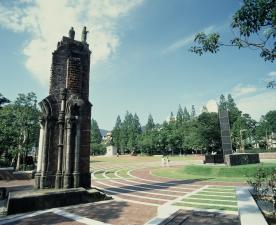
Nagasaki Hypocenter Park
At 11:02 am, August 9th, 1945: an atomic bomb detonated 500 meters above Matsuyama in Nagasaki City. Large numbers of people were killed immediately, while others died later from illness or injury - by the end of December, some 74,000 people had died while around 75,000 more suffered from injuries associated with the event. The area within a 2.5 kilometer radius of the hypocenter was utterly devastated, and the rest of the city was left in ruins. In 1968, a memorial monolith was built in the hypocenter park to mark ground zero of the atomic explosion. Beside the monolith, a part of the relics of the former Urakami Cathedral is preserved. A layer of the ground at that time is exhibited at the site, where visitors can see the remains of destroyed houses: roof tiles, bricks, ceramic and pieces of glass that boiled in the 3000℃ atomic heat. After the bombing, which destroyed all plant life around the hypocenter, people said that no plants would grow there for the next 70 years. However, one month after the atomic bombing, about 30 kinds of plants started to grow again. Today, there are bout 500 cherry blossom trees in the hypocenter park. The park is a favorite spot among local people for cherry blossom viewing in the spring time and as a green-filled oasis throughout the year. It truly captures the power of revival. Take a stroll around the many sites in the area: the Atomic Bomb Museum, the National Peace Memorial Hall for the Atomic Bomb Victims, the Peace Park, Urakami Cathedral with its atomic-bombed statue of the Virgin Mary, the Dr. Nagai Museum (a doctor and survivor of the atomic bombing), the local elementary school affected by the bombing with its own peace museum, the one-legged torii gate of Sanno Shrine and its surrounding camphor trees that survived the bombing. These are all located within walking distance. -
99
The Nagasaki Museum of History and Culture
The Nagasaki Museum of History and Culture is one of Japan’s leading museums covering the story of international exchange. It has many exhibitions of precious historical materials from Nagasaki’s modern history, works of art and ancient writings. It also shows a part of the restored Tateyama branch of the Edo-period Nagasaki magistrate’s office where visitors can enjoy a short drama performance. The craft center offers hands-on classes of Nagasaki’s traditional crafts. -
100
Santo Domingo Church Museum
In 1609, Fr. Francisco Morales, a Dominican priest, suffered persecution and watched as his church in Kyodomari was taken down. But the dismantled materials were brought to Nagasaki and used to build another church on land provided by Murayama Toan, a local magistrate who professed Christianity. However, the newly built church was also destroyed soon afterward in obedience to the Anti-Christian Edicts. The site, where an elementary school is now located, became the residence of the deputy administrator of the shogunate. Recently, during the demolition and reconstruction of the old building, relics of the church and residence were discovered. A museum was opened on the site, and the unearthed objects are now on display as important artifacts related to the early Edo period. -
101
Gunkanjima Digital Museum
Gunkanjima, or Battleship Island are popular names for Hashima, the coal mining island that played a vital role in Japan’s Meiji Industrial Revolution. This digital museum uses cutting edge technology to recreate the island in its heyday. -
102
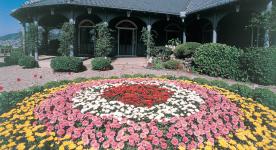
Glover Garden
This garden has been designated as an Important Cultural Asset. Here you can visit the beautiful traditional homes built for British merchants, including the oldest wooden Western-style home in Japan, built by the Scottish merchant Thomas Glover, who exerted a strong influence on the industrialization of Japan. The garden is lush with flowers, and has a stunning view of Nagasaki Port. The Christmas illuminations in winter time are also worth to visit. -
103
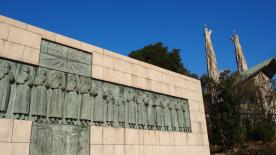
Site of the Martyrdom of the 26 Saints of Japan
On February 5, 1597, twenty-six Catholics were executed here under the orders of Toyotomi Hideyoshi, marking the beginning of a two century long period of harsh Christian persecution in Japan. Today, this spot on Nishizaka Hill has been designated a Japanese National Sanctuary. Pope St. John Paul II visited this site on February 26, 1981 as a pilgrim for the martyrs. Background In the late 1500s, the government had begun to grow wary of foreign influence. To gain complete control over Kyushu, Toyotomi Hideyoshi issued an order to expel all priests from the country. The growing tension culminated in the arrest of six missionaries (including Spaniards, Mexicans, and Portuguese) and eighteen Japanese Christians in Kyoto and Osaka (some of whom had come from Nagasaki). They were forced to make the 800km walk to Nagasaki, chosen for its significant Christian population. They were joined by two more Catholics along the way. The journey took a month to complete, and when they finally made it to Nishizaka Hill, they were executed in front of the masses. Many more tragically followed. The martyrs were beatified in 1627, and canonized by the Pope in 1862. The Twenty-Six Martyrs Monument A monument dedicated to St. Paul Miki and his twenty-five companions was built at the site of the martyrdom in commemoration of the 100th anniversary of their canonization. This monument faces Oura Cathedral which is also dedicated to the martyrs. The Twenty-Six Martyrs Museum Behind the monument stands the Twenty-Six Martyrs Museum. At this museum, visitors can learn about the history of Christianity in Nagasaki - its rise, its prohibition, and its revival. A collection of items showcasing the lives of Christians as they hid from the authorities are on display here. These artifacts include the scroll Our Lady of the Snows (meticulously preserved by the faithful Hidden Christians in spite of the risk it posed), the "Maria Kannon" – a figurine shaped like the Buddhist Kannon used by Hidden Christians as the statue of Mary for worship, and personal belongings amongst others. There is also a collection of old maps and an original letter of St Francis Xavier's. A replica of the scroll of St. Mary of the Snows appears in the movie Silence (more information under Topics). Twenty-Six Martyrs Memorial St. Philip's Church (Nishizaka Church) Prominent for its uniquely designed twin towers that one may catch a glimpse of in the city area, this church, influenced by Gaudi and designed by Kenji Imai, is a church named after one of the martyrs. St. Paul Miki, St. Jacob Kisai, and St. John Goto's bones are stored here. This church is currently open for prayer and receives pilgrims from many nations every year. -
 104
104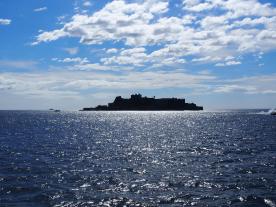
Hashima (Gunkanjima, Battle Ship Island)
Hashima is also known by its nickname “Gunkanjima” (Battleship Island) due to its unique silhouette. This island has been added to the List of UNESCO World Heritage Sites for its historical value based on its industrial heritage in 2015, as a component of "Sites of Japan’s Meiji Industrial Revolution: Iron and Steel, Shipbuilding and Coal Mining (Japan)." It has also been getting world-wide attention as it was the model for the “Dead City” in the James Bond movie “Skyfall” (2013). "Attack on Titan" (2015) was also filmed on this island. Gunkanjima flourished as a coal mining community since 1890. In 1974 when the coal mine closed, the island became completely deserted. Today, boat tours are offered to Hashima. -
105
Megane-bashi (Spectacles Bridge)
Megane Spectacles BridgeThe Nakashima River runs through a series of picturesque 17th-century stone bridges. Best-known is the double-arched Megane-bashi, or Spectacles Bridge, so called because the reflection of the arches in the water looks like a pair of eyeglasses. It was originally built in 1634, and was Japan’s oldest stone bridge. Unfortunately it was washed away by floodwaters in the 1982 disaster which killed 299 people, but was later restored using the recovered stones.Try spotting a heart-shaped stone near to the bridge and make a wish for eternal love. -
106
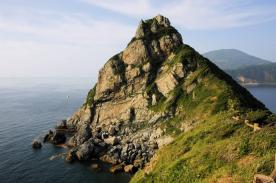
Yagatame Park
Approaching the peaceful town of Nama from Aosagaura, Yagatame Park’s unique rock formation is hard to miss. Dubbed Nagasaki’s Totoro Rock, one can make out Ghibli’s famed character gazing out towards the East China Sea. Come summer, vibrant orange tiger lilies come to bloom, further enhancing the majestic view of the sun setting over the East China Sea. The sunset can be viewed from either the observation grounds of Yagatame Park that brings you closer to the cone-shaped rock, or Shirakusa Park near Goto’s resort hotel, Margherita. Nearby is a souvenir shop selling Goto’s unique products, most notable of which are varied flavours of Yagatame’s sea salt, made in the same area, as well as sea salt ice cream in the summer. -
107
Fukusaiji
An impressively large Kannon (Goddess of Mercy) stands atop a mausoleum with a turtle-shaped roof, serenely watching over the streets of Nagasaki city at this distinctive temple. Fukusaiji, together with Kofukuji, Shofukuji, and Sofukuji, comprise the “four fortune temples of Nagasaki” (長崎四福寺). -
108
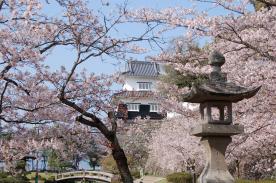
Omura Park
Omura Park was built over the outer moat of the former Kushima Castle. The park is filled with 300 blossoming cherry trees in spring and has been selected as one of “Japan’s Top 100 Cherry Blossom Spots”. Omura Sakura is said to be the most graceful cherry blossom with 60 to 100 petals per flower, while the ordinal cherry blossom has 5 petals. At the beginning of summer, some 300,000 irises bloom in the park.